
Stress can disrupt family communication by increasing emotional reactions, leading to misunderstandings, frequent arguments, or complete communication shutdowns. It impacts both adults and children, making it harder to connect and solve problems. However, research shows that clear, open communication reduces stress and strengthens family bonds. Simple strategies like active listening, empathy, setting routines, and addressing physical health issues can create a calmer, more supportive home environment.
Key Takeaways:
- Stress amplifies emotions, causing overreactions or withdrawal.
- Misunderstandings grow when stress limits focus and listening.
- Children and teens feel the effects, often hiding their struggles.
- Effective communication reduces stress, improves coping, and builds resilience.
- Strategies include: active listening, empathy, clear boundaries, and managing physical health.
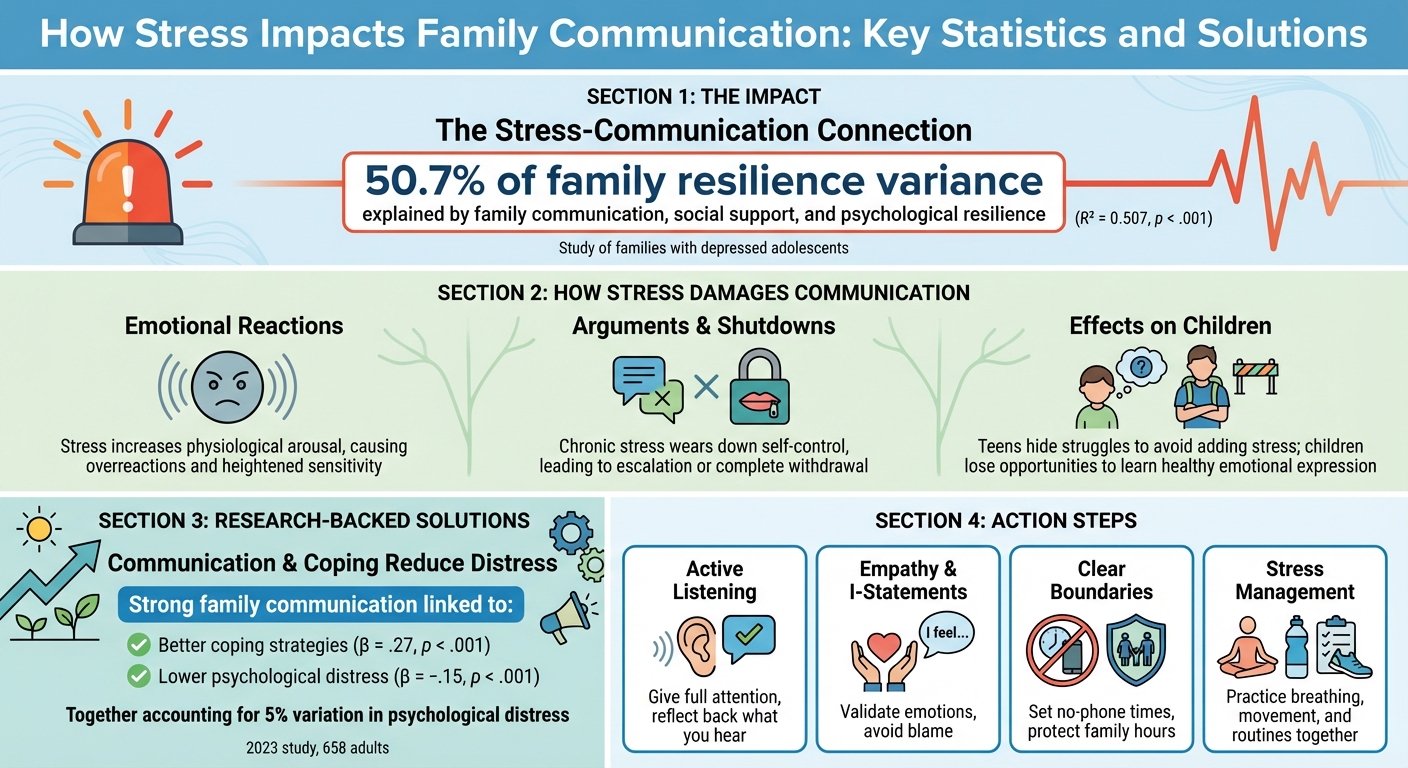
How Stress Impacts Family Communication: Key Statistics and Solutions
How Stress Damages Family Communication
Stronger Emotional Reactions and Misunderstandings
When stress takes over, emotions tend to run high, and even small issues can feel like major problems. Family members may overreact, raise their voices, or retreat entirely. Studies reveal that stress increases physiological arousal, making people more easily frustrated and overly sensitive to what they perceive as threats. For instance, a simple question like "Did you pick up the groceries?" might come across as criticism or nagging, sparking defensiveness instead of a straightforward reply.
Stress also limits our ability to focus, making it harder to truly listen or interpret nonverbal cues like tone and body language. Picture this: a teenager gives a one-word answer, which might actually signal anxiety about an upcoming test. Or a partner’s silence, which could simply mean they’re exhausted, might be misread as anger or indifference. Over time, these small misunderstandings can pile up, creating unintended emotional wounds and widening the gap between family members.
More Arguments and Communication Shutdowns
These miscommunications often set the stage for bigger problems. Stress has a way of turning minor disagreements into heated arguments, and those arguments can quickly spiral out of control. Chronic stress wears down self-control, making it easier for discussions about chores or finances to escalate into shouting matches filled with criticism, sarcasm, or even old grievances resurfacing. For example, families juggling tight budgets or long work hours often find that stress shortens their patience, leaving little room for calm, productive conversations.
On the flip side, some people respond to stress by shutting down communication altogether. Overwhelmed family members may withdraw – spending more time alone, burying themselves in their phones, or giving one-word answers to avoid conflict. While this avoidance might reduce tension temporarily, it often adds to emotional distress and leaves important issues unresolved. Parents, for instance, might avoid difficult conversations about finances or health to "keep the peace", unintentionally teaching children that uncomfortable emotions should be ignored. This avoidance can lead to greater emotional distance within the family.
Effects on Children and Teens
Stress doesn’t just affect adults – it trickles down to children and teens, shaping how they feel and communicate. Research shows that stressed-out parents often become less patient and emotionally available, which means kids lose valuable opportunities to learn how to express and manage their feelings in a healthy way. This can result in children acting out with tantrums, defiance, or sibling fights. Others may withdraw, spending too much time alone and hesitating to share concerns about school or friendships.
One study focusing on families with depressed adolescents found that family communication, social support, and psychological resilience accounted for 50.7% of the variance in family resilience (R² = 0.507, p < .001). Teens in high-stress households often admit they "don’t want to add to the stress", so they hide their struggles with anxiety, school pressures, or social problems. This delays parents from recognizing issues early on and addressing them. The result? A home environment where everyone feels overwhelmed and disconnected, but the conversations that could bring relief remain unspoken. These patterns highlight the importance of finding ways to rebuild open, healthy communication within families.
Research-Based Ways to Improve Family Communication During Stress
Using Active Listening and Empathy
Research highlights practical strategies to break the cycle of stress and poor communication. One of the most effective tools is active listening. This involves giving someone your full attention – putting away phones, turning off the TV, and maintaining eye contact. These actions help you pick up on tone and body language, not just the words being said. For instance, when a family member shares a concern, try reflecting back what you heard: "It sounds like you’re feeling overwhelmed with your homework and practice schedule. Is that right?" This approach reduces misunderstandings and shows you’re truly listening.
Pairing active listening with empathy strengthens this connection. Start by validating their emotions with statements like, "I can see why that would be upsetting." This kind of acknowledgment helps calm emotions and encourages more constructive conversations. Using "I-statements" instead of blaming language is another key tool. For example, say, "I feel worried when we yell because it makes solving the problem harder", rather than, "You always yell at me."
Even small habits, like a nightly 10-15 minute family check-in where everyone shares one high and one low from their day, can build trust over time. These moments create a safe space for open dialogue. Combined with consistent routines, they set the stage for more peaceful and productive family interactions.
Setting Clear Boundaries and Daily Routines
When stress levels rise, structure becomes essential. Predictable routines – like consistent wake-up times, regular meals, set homework hours, and bedtime rituals – offer a sense of stability. For example, a simple morning routine of waking up at the same time, eating breakfast together, and preparing backpacks the night before can cut down on last-minute chaos and prevent conflicts.
Boundaries are equally important, especially around technology and work. Instituting "no-phone" times, such as during dinner or a family chat, limits distractions and fosters emotional connection. Parents can also set boundaries for themselves, like avoiding work emails or calls after a certain time, to protect family time and reduce stress. Many families find it helpful to create a written "family agreement" with a few basic rules, such as "We speak respectfully", "We ask before borrowing", or "No work emails after 8:00 p.m." Posting this agreement on the fridge and revisiting it regularly allows everyone – kids included – to contribute and feel involved.
Stress Management Techniques for Families
In addition to communication and routines, shared stress-reduction practices can stabilize family dynamics. Families can try stress-relief techniques together to help everyone stay calm and focused. For example, taking three to five slow belly breaths before discussing a tense issue can lower heart rates and improve emotional control. A short five-minute body scan or grounding exercise after dinner can help family members notice stress signals early and respond thoughtfully instead of reacting impulsively.
Simple activities like evening walks or backyard games encourage movement and connection, which can lift everyone’s mood and improve overall family harmony. Some families even set aside a "no-conflict" time each week to focus on play, gratitude, or lighthearted conversations rather than serious issues. Scheduling these practices – whether it’s after dinner or before bedtime – and linking them to existing routines makes it easier to stick with them.
A 2023 study involving 658 adults found that strong family communication was linked to better coping strategies (β = .27, p < .001) and lower psychological distress (β = −.15, p < .001). Together, communication and coping accounted for 5% of the variation in psychological distress. This research underscores how open conversations and stress-management habits can help families handle challenges like financial pressures, health issues, or packed schedules without falling into constant conflict.
How Physical Health Affects Family Communication
Finding and Treating the Root Causes of Stress
Physical health challenges can significantly impact how families communicate. Imagine a parent waking up with chronic back pain or a teenager constantly battling fatigue – these physical struggles often become a breeding ground for stress. And that stress doesn’t just sit quietly in the background; it seeps into daily interactions, fueling impatience, emotional outbursts, and even misunderstandings.
The patterns are often predictable. A parent dealing with persistent headaches or poor sleep might lose their temper over minor issues or withdraw entirely. Children, sensing this tension, may hesitate to express themselves openly. Over time, this dynamic chips away at the supportive, open conversations that are so crucial for emotional well-being. The connection between physical health and family communication becomes unmistakable when untreated issues – like migraines, digestive troubles, or hormonal imbalances – keep the body in a constant state of stress. Elevated cortisol levels and an overactive nervous system can lead to irritability, anxiety, and low mood. For instance, a parent with frequent migraines might cancel family plans and focus only on practical matters, leaving little room for emotional bonding.
On the flip side, when physical health improves – through better sleep, pain relief, or increased energy – families often experience a noticeable shift. Patience grows, tones soften, and resolving conflicts becomes easier. Addressing physical wellness doesn’t just improve individual health – it creates a ripple effect, fostering healthier and more positive family interactions.
How Gonstead Chiropractic and Wellness Care Support Families
Tackling these physical health issues can help restore calm and constructive communication within families. Gonstead chiropractic care offers a targeted approach, using precise spinal X-rays, motion palpation, and specialized tools to pinpoint vertebral misalignments that may disrupt nerve function. Through hands-on adjustments, this method aims to restore proper alignment and reduce nerve interference – potentially easing irritability and tension at home.
Kinnection Clinic takes this a step further by combining Gonstead chiropractic care with other wellness practices like functional medicine, hormone support, IV therapy, and comprehensive family health services. For example, a parent struggling with chronic lower back pain and fatigue might undergo a Gonstead evaluation to address their discomfort, helping them become more patient and present in family life. Similarly, a teenager dealing with headaches and anxiety could benefit from functional medicine, which might uncover issues like unstable blood sugar or nutrient deficiencies. Addressing these root causes can lead to fewer mood swings and more productive conversations.
sbb-itb-d9e542d
Reducing Family Stress and Increasing Coping
Conclusion: Strengthening Family Relationships Through Stress Management
Unchecked stress can quietly chip away at the foundation of family relationships. It fuels conflicts, drains patience, and makes it harder to truly understand one another. However, by prioritizing open communication and effective coping strategies, families can navigate even the toughest challenges while reinforcing their bonds. The secret lies in treating stress management as a team effort – something the entire family works on together, rather than leaving it to one individual.
When families commit to honest conversations, empathetic listening, and tackling stressors head-on, they create a supportive home environment. This approach not only nurtures children’s emotional development but also promotes better mental health for everyone involved. Parents who manage their own stress effectively can maintain a sense of warmth and availability, breaking the cycle where stress spills over into future generations.
Beyond communication, a well-rounded approach to wellness is essential. For families in the U.S. juggling hectic schedules, work pressures, and health challenges, this might mean sharpening communication skills, seeking mental health resources, and prioritizing physical well-being. Kinnection Clinic offers a holistic approach, combining Gonstead chiropractic care, functional medicine, hormone support, IV therapy, and family wellness programs – all aimed at addressing the root causes of stress rather than just its symptoms.
As Robert B., a client, put it: "Kinnection Clinic truly fixes the root cause, not just symptoms, with personalized care that delivers real, lasting relief."
This kind of integrated care highlights the powerful connection between physical health and strong family dynamics.
Start by sitting down as a family to discuss major stressors, brainstorm realistic changes, and determine what kind of support – whether from a therapist, doctor, or wellness clinic – might be needed. By treating stress management as an ongoing, shared effort, families can create deeper connections and a healthier, happier future for everyone involved.
FAQs
How does active listening help ease stress in family communication?
Active listening plays a key role in reducing stress during family interactions by fostering mutual understanding and demonstrating empathy. When you genuinely listen – without cutting in or passing judgment – it sends a powerful message to your loved ones: their feelings and perspectives matter. This approach helps to minimize misunderstandings, ease tensions, and create a safe space for honest and open dialogue.
By paying close attention to what’s being said, recognizing the emotions behind the words, and responding with care, active listening strengthens trust and deepens connections, even in challenging or high-stress situations.
How does stress affect children and teens in a family environment?
Stress can deeply affect children and teens in a family environment. It can heighten anxiety, strain communication, and lead to behavioral issues. If left unchecked, ongoing stress may hinder emotional development and make it challenging for young family members to form positive relationships.
Creating a space for open and supportive communication is key to easing stress and fostering a more caring atmosphere. When necessary, turning to professional support can also enhance family bonds and help children and teens develop resilience.
How can families manage communication challenges caused by stress?
Managing stress-related communication problems in families begins with open, calm discussions where everyone has the chance to share their thoughts and feelings without judgment. Practicing active listening – truly focusing on what others are saying without interruptions – can make a big difference. Setting aside quality family time for genuine, meaningful conversations also helps build stronger bonds.
On a personal level, incorporating relaxation techniques like deep breathing exercises, mindfulness practices, or even regular physical activity can help ease stress and create a better environment for communication. If these efforts don’t resolve the issues, reaching out for professional help can offer useful strategies and support. Tackling stress head-on can pave the way for healthier conversations and closer family relationships.